
Shower Spotlights: IP Rating, Safety, and Tips for Choosing the Right One
Installing a spotlight above the shower is an excellent solution for achieving precise, discreet, and comfortable lighting in the bathroom. But in this area exposed to water, steam, and humidity, the choice of fixture should never be based solely on design. You must first verify that the spotlight is suitable for installation in a damp room.
A spotlight above the shower must meet more demanding criteria than a spotlight installed in a living room, kitchen, or hallway. The shower is one of the most sensitive locations in the bathroom: the fixture can be exposed to water splashes, condensation, and repeated humidity. The right choice therefore depends on the IP rating, installation zone, type of mounting, and desired lighting comfort.
In this article, we explain which spotlight to install above a shower, which IP rating to prioritize, how to understand safety zones in the bathroom, and which mistakes to avoid to achieve pleasant and reliable lighting.
Summary
- Can you install a spotlight above a shower?
- Understanding zones and locations in the bathroom
- Which IP rating should you choose for a spotlight above the shower?
- IP44, IP65, or IP67: what are the differences for a shower?
- Recessed spotlight or surface-mounted spotlight: which to choose for the ceiling?
- What color temperature should you choose for a shower?
- How many spotlights should you plan for in a shower?
- How to avoid glare in the shower?
- Mistakes to avoid with a shower spotlight
- Choosing your shower lighting with La Lumiere

Can you install a spotlight above a shower?
Yes, it is possible to install a spotlight above a shower, provided you choose a fixture suitable for this location. This is a very common solution in contemporary bathrooms because it allows for direct, clean light that integrates well into the ceiling.
The spotlight above the shower is particularly useful in a walk-in shower, an enclosed cabin, a large washroom, or a bathroom where general lighting is insufficient to properly illuminate the washing area. It provides targeted light, avoids dark spots, and improves daily comfort of use.
But this location requires caution. A standard decorative spotlight is not necessarily suitable for a shower. Even if the fixture is attractive, it must be designed to withstand humidity and water splashes. The product’s technical sheet should therefore be checked before purchase.
The choice of spotlight should follow a simple logic: safety first, lighting effect second. Once the protection rating and compatibility with the bathroom are confirmed, it becomes possible to choose the design, finish, color temperature, and light intensity.
Understanding zones and locations in the bathroom

In a bathroom, not all locations present the same level of risk. A light fixture placed near a mirror, in the center of the ceiling, or directly above the shower will not be exposed to water and humidity in the same way.
The area above the shower is one of the most sensitive. The spotlight may receive steam, condensation, and sometimes direct splashes depending on ceiling height, jet power, presence of a screen, or shower configuration. That is why you need to choose a fixture designed for this use.
To better understand the different possible locations in a bathroom, you can consult our complete guide: which lighting to choose for your bathroom. It helps distinguish needs according to zones: mirror, ceiling, shower, bathtub, vanity unit, or ambient lighting.
For a spotlight above the shower, it is recommended to have the installation validated by a professional, especially during renovations. The bathroom remains a technical room, and electricity must be handled with particular care.
Which IP rating should you choose for a spotlight above the shower?
The IP rating indicates the level of protection a fixture has against solid objects and water. In a bathroom, it is one of the most important criteria to check. For a spotlight above the shower, the IP rating must be suitable for a humid area potentially exposed to splashes.
An IP65 shower spotlight is often the most relevant choice for installation above the shower. The IP65 rating means the fixture is protected against dust and water jets. This level of protection is particularly suited to areas with high and repeated humidity.
For installation above the shower, it is best to choose a fixture designed for areas exposed to moisture, such as an IP65 shower spotlight, when the location and electrical constraints allow.
You should not settle for a spotlight simply labeled as “bathroom compatible.” Some fixtures may be suitable for areas away from the shower but not appropriate above the shower tray. The exact IP rating must always be checked.
IP44, IP65, or IP67: what are the differences for a shower?

The most common IP ratings in bathrooms are IP44, IP65, and IP67. They do not correspond to the same level of protection or the same use.
An IP44 spotlight may be suitable in certain bathroom areas exposed to humidity or light splashes. It can be installed near a sink or in a less exposed part of the room, depending on the setup. However, it is not always sufficient for installation directly above the shower.
A bathroom spotlight IP65 offers higher water protection. It is generally better suited for a shower area, especially when the fixture is placed on the ceiling above the tray, in a walk-in shower, or in a space where steam and splashes are frequent.
An IP67 spotlight offers even higher protection, especially against temporary immersion. This level can be useful in very specific cases but is not necessarily required for a standard shower ceiling. The choice depends on the actual configuration: ceiling height, open shower, enclosed shower, directed jets, or particularly humid environment.
The right question is not just to choose the highest rating, but to choose the rating appropriate for the location. In most cases, for a spotlight above the shower, IP65 provides a very reassuring base level of protection.
Recessed spotlight or surface-mounted spotlight: which to choose for the ceiling?
The recessed shower spotlight is highly appreciated for its discreet appearance. It integrates directly into the ceiling and provides a clean finish, particularly suited to contemporary bathrooms. In a walk-in shower, it helps maintain a very streamlined visual line.
In a contemporary bathroom, a recessed bathroom spotlight offers a discreet ceiling finish, provided the protection rating and compatibility with the intended location are verified.
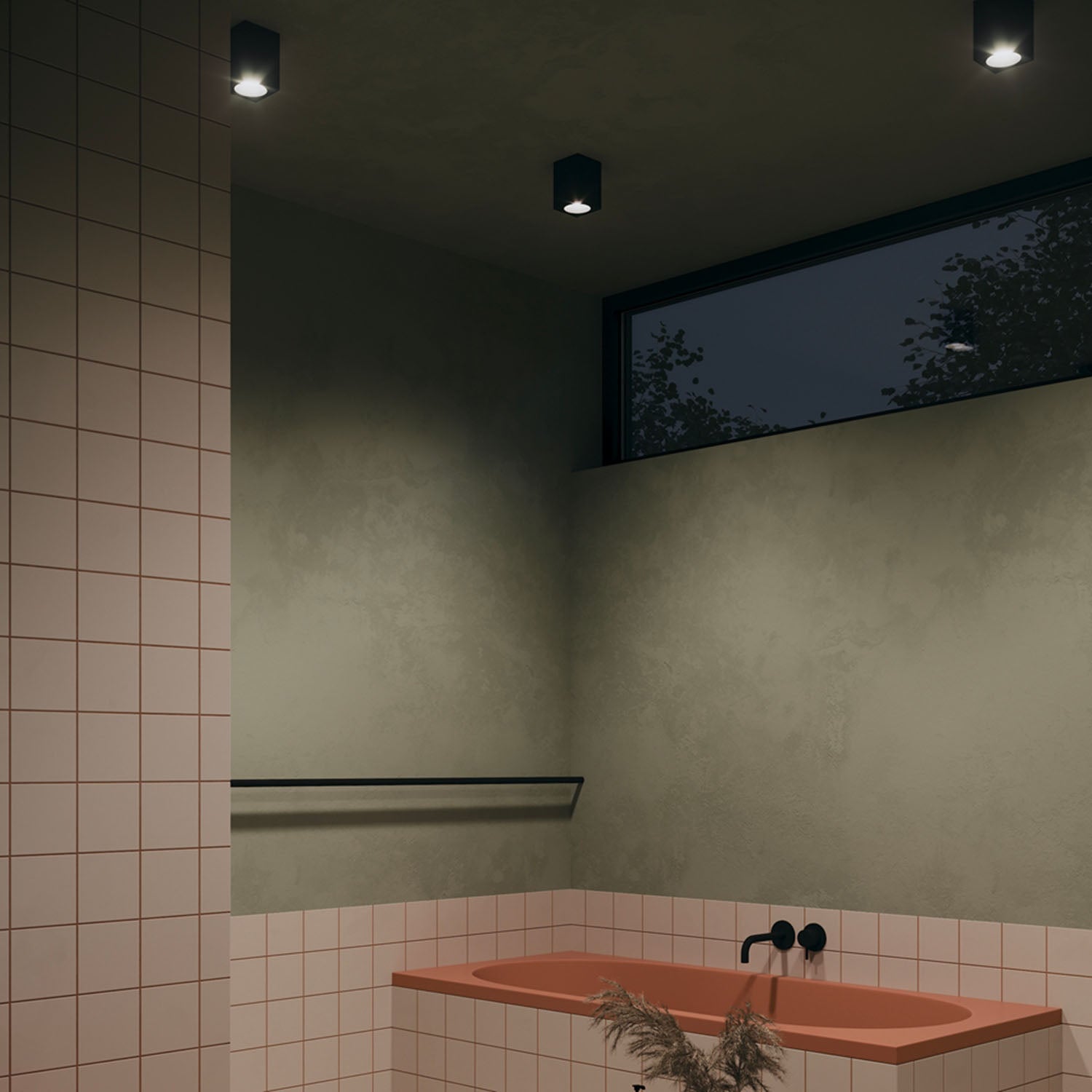
A surface-mounted spotlight can be an interesting alternative when recessed installation is not possible. This is often the case in renovations, where there is no false ceiling or the available height does not allow for a recessed spotlight. However, it must have a protection rating suitable for the shower area.
The choice between recessed and surface-mounted lighting depends as much on technical factors as on aesthetics. If the ceiling allows, recessed lighting remains very discreet. If installation is not possible, a well-chosen surface-mounted spotlight can provide an effective solution, provided it is suitable for the bathroom.
What color temperature should you choose for a shower?

Color temperature strongly influences the ambiance of the bathroom. In a shower, it is important to find a balance between comfort, visibility, and natural rendering. Light that is too cool can feel clinical. Light that is too warm can be pleasant but sometimes less precise for everyday tasks.
For shower lighting, light around 3000K is often a good compromise. It remains warm without being too yellow and suits modern bathrooms well. It helps create a pleasant atmosphere both morning and evening.
In a very functional bathroom, slightly more neutral light can be considered. This may suit a bathroom used mainly in the morning or a room where more precise lighting is desired. But avoid a strong break with the rest of the bathroom lighting.
If the sconces around the mirror, the ceiling light, or other spotlights are warm light, a very white shower spotlight may create an unharmonious contrast. Ideally, maintain consistent lighting throughout the room.
How many spotlights should you plan for in a shower?
The number of spotlights depends on the size of the shower, ceiling height, fixture power, and desired light level. In a standard shower, a single well-chosen spotlight may be enough. In a large Italian shower or a double shower, two light points can be more comfortable.
A shower ceiling light must sufficiently illuminate the area without creating overly harsh light. In a small cabin, a spotlight that is too powerful can become uncomfortable. In a large shower, a spotlight that is too weak can leave some areas in shadow.
A waterproof spotlight for shower ceiling can provide precise and comfortable light without multiplying light points in a small cabin.
You also need to consider the general lighting of the bathroom. If the room is already well-lit, the shower spotlight can be more focused. If the shower is in a recess, behind an opaque panel, or in a dark area, it will need to provide more light.
How to avoid glare in the shower?
Glare is an important issue because in the shower, the gaze can naturally be directed towards the ceiling. A spotlight that is too powerful, too direct, or poorly diffused can become bothersome, especially in a small cabin or with a low ceiling.
To avoid this effect, you need to choose a spotlight with well-controlled light. A diffuser, an appropriate angle, or a slightly recessed source can improve visual comfort. The goal is to illuminate the shower area without sending harsh light directly into the eyes.
In an open walk-in shower, the spotlight can sometimes be slightly offset from the exact center of the shower area. This allows effective lighting without placing the light source directly above the drain. The position naturally depends on the ceiling configuration and electrical installation.
Bathroom materials also affect the lighting effect. Glossy tiles, glass, or very light-colored faience can strongly reflect light. In this case, it’s better to opt for moderate power and well-diffused light.
Mistakes to avoid with a shower spotlight
The first mistake is installing a standard spotlight above the shower without checking its IP rating. A fixture not suited for humidity can deteriorate quickly and should not be used in such an exposed area.
The second mistake is confusing the bathroom with the shower zone. A spotlight may be suitable for part of the bathroom but not necessarily above the shower tray or walk-in shower. The exact location must always be considered.
The third mistake is choosing light that is too cold. In a shower, very white light can create an unpleasant atmosphere, especially if the rest of the bathroom is designed with a softer ambiance.
The fourth mistake is over-lighting a small shower. A spotlight that is too powerful can cause glare and make usage uncomfortable. It’s better to choose sufficient, well-diffused light suited to the size of the space.
Finally, installation should not be overlooked. Electrical work in the bathroom must be carried out or approved by a qualified professional, taking into account the location, type of fixture, and the specific constraints of the wet room.
Choosing your shower lighting with La Lumiere
To choose a spotlight above the shower, you first need to check the technical criteria: IP rating, humidity compatibility, mounting type, ceiling height, and lighting comfort. Design comes next, once the installation conditions are confirmed.
Good bathroom shower lighting should be reliable, discreet, and pleasant. It must allow you to see well in the shower without causing glare or disrupting the overall bathroom atmosphere.
At La Lumiere, we offer spotlights suited for bathroom projects, with models designed to meet the requirements of wet zones. The goal is to choose a light fixture that matches your installation, ceiling, and desired ambiance.


Leave a comment
This site is protected by hCaptcha and the hCaptcha Privacy Policy and Terms of Service apply.