
Replacing recessed spotlights with a light rail: good or bad idea?
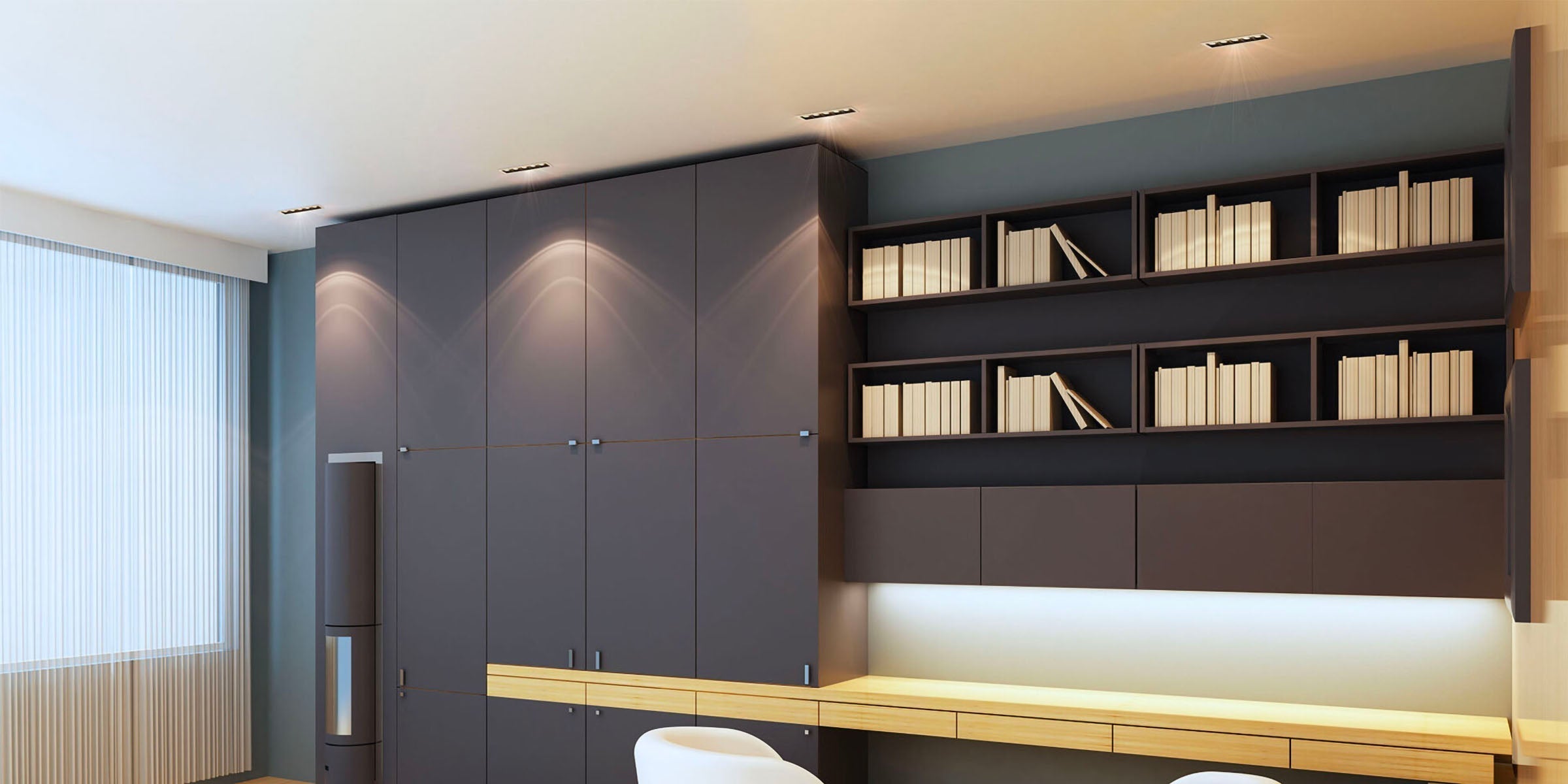
Recessed spotlights have long been a widely used solution to light a living room, kitchen, hallway, shop, or professional space. Discreet, integrated into the ceiling, and relatively easy to distribute, they provide effective general lighting. But during a renovation, they sometimes show their limits: fixed installation, too uniform light, lack of flexibility, or a look that has become too classic.
Replacing recessed spotlights with a light rail can then become an interesting solution. The rail allows moving, directing, and multiplying light sources according to the needs of the space. It offers more freedom than a fixed spotlight, while adding a more architectural dimension to the lighting.
But this transformation should not be decided solely for aesthetic reasons. Before replacing recessed lighting with a rail, it is important to understand the ceiling constraints, the available electrical supply, the management of old holes, the type of suitable rail, and the actual use of the room.
Summary
- Why consider replacing recessed spotlights?
- What is a light rail?
- Recessed spot or light rail: what are the differences?
- The advantages of the light rail in renovation
- Limits to know before replacing recessed spotlights
- What to do with old recessed spotlight holes?
- Replacing recessed spotlights with a light track in a living room
- Installing a light track in a kitchen or dining room
- Using light rails in a shop, gallery, or showroom
- Should you choose a single-phase, three-phase, or magnetic rail?
- How to properly position a ceiling light track?
- Mistakes to avoid in a replacement project
-
Choosing your rail lighting with La Lumiere

Why consider replacing recessed spotlights?
Recessed spotlights can be effective, but they are not always suited to the evolution of a space. When a ceiling has been designed with several fixed light points, it becomes difficult to change the ambiance or redirect the light without intervening again on the ceiling.
In a living room, recessed spotlights can produce light that is too uniform, sometimes flat, with little depth. In a shop, they may no longer match the product layout. In an office or showroom, they can lack flexibility if the layout changes regularly.
The problem often comes from their installation. A recessed spotlight illuminates from a specific point. Once the ceiling is pierced, the location is fixed. If the furniture changes, if a table is moved, if a piece of art is added to the wall, or if one area becomes more important than another, the lighting does not always follow.
It is in this context that the question arises: should the existing spotlights be kept, replaced with new models, or switched to a more flexible system like a light rail?
What is a light rail?

A light rail is a lighting system composed of a rail fixed to the ceiling or wall, on which different light fixtures can be positioned. It can accommodate adjustable spotlights, compatible pendants, floodlights, or light modules depending on the type of rail chosen.
The main advantage of the rail is its modularity. Unlike a recessed spot, the fixture is not permanently fixed to one location. It can be moved along the rail, oriented differently, or complemented by other light sources. This flexibility is especially useful in spaces that change over time.
A ceiling light rail can be used in a living room, kitchen, hallway, shop, restaurant, gallery, or office. It allows you to create general lighting but also to direct light toward a table, work surface, wall, display case, counter, or product.
Depending on the desired style, the rail can be very discreet or, on the contrary, become a graphic element of the ceiling. A simple model like the ceiling spot on rail can, for example, suit a project where you want an efficient, contemporary, and easy-to-integrate solution.
Recessed spot or light rail: what are the differences?
The main difference between a recessed spot and a light rail concerns freedom of orientation and evolution. A recessed spot is integrated into the ceiling. It can sometimes be adjustable, but its location remains fixed. The rail, on the other hand, allows you to change the position of the fixtures along an existing line.
A recessed spot or light rail therefore does not meet exactly the same need. The recessed spot is suitable when you want a discreet, integrated, and permanent solution. The light rail is better suited when you want to be able to adjust the lighting, create light accents, or evolve the layout.
In a renovation, this difference is important. If the placement of the old spots no longer fits the room, replacing them with new spots in the same location won’t necessarily solve the problem. A rail can allow you to reuse an existing power supply while adding flexibility to the lighting design.
The visual effect also changes. Recessed spots almost disappear into the ceiling, while the rail makes its presence more noticeable. It can give a more architectural, professional, or contemporary style, depending on the finish, length, and fixtures used.
The advantages of the light rail in renovation
The first advantage of the light rail is its flexibility. It allows you to direct the spots according to the areas to be illuminated: table, sofa, bookshelf, work surface, painting, counter, shelf, or display. This adjustment capability is especially useful when a room has multiple uses.
The second advantage is flexibility. If the layout changes, it is possible to move some spots on the rail or add more as needed, within the limits of the chosen system. This flexibility avoids having to redo the entire installation with every room modification.

The third advantage is the quality of staging. An adjustable spot on a rail allows for more precise accent points than uniform lighting. You can highlight a material, an object, a passage area, or a textured wall, rather than lighting the entire room with the same intensity.
Finally, the rail can be an interesting solution when you want to avoid multiplying new ceiling drillings. In some projects, it is possible to use an existing power point to create a more relevant light line.
Limits to know before replacing recessed spotlights
Replacing recessed spotlights with a light rail is not always the best solution. The first point to check is the condition of the ceiling. If the old spotlights have left many holes, repairs will be necessary: filling, plastering, painting, or sometimes creating a partial false ceiling.
The second point concerns electrical power supply. A rail must be properly powered, positioned, and connected. It is not enough to remove the existing spotlights and randomly fix a rail. The intervention of a professional is highly recommended, especially if the current installation is old or complex.
The third point is aesthetic. A light rail is more visible than a recessed spotlight. You must therefore accept its presence on the ceiling. In some very minimalist interiors, one might sometimes prefer to keep discreet recessed spotlights or choose a particularly slim rail system.
Finally, care must be taken not to overload the rail. Too many spotlights on the same line can create a technical or even commercial look in a residential room. The goal is to create more flexible lighting, not to turn the ceiling into a showroom unless that is the desired effect.
What to do with old recessed spotlight holes?
The issue of old holes is one of the most important points in a replacement project. Recessed spotlights require drilling into the ceiling. When they are removed, these openings remain visible and must be properly treated.
In most cases, several solutions are possible. The first is to fill in the old holes, then redo the ceiling plaster and paint. This is often the cleanest solution when you want to start fresh with a new lighting layout.
The second option is to use one of the old electrical points to power the track, then fill in the other holes. This solution can be interesting if the existing power supply is in a location consistent with the future track.
The third option is to position the track along the axis of the old spotlights. In some cases, this simplifies the work and limits visible repairs. But this option is only relevant if the existing alignment truly matches the new use of the room.
You should avoid choosing the track’s location just to hide old holes. The track must first follow a lighting logic: which areas need to be lit, in which direction, with what intensity, and for what use?
Replacing recessed spotlights with a light track in a living room
In a living room, recessed spotlights often create a fairly uniform general light. This can be practical but sometimes insufficient to create a warm atmosphere. The living room is a living space with several zones: sofa, coffee table, bookshelf, reading corner, decorative wall, TV unit, or dining area in the case of an open-plan room.
A living room light track helps better organize these zones. Adjustable spotlights can be directed toward a textured wall, artwork, shelf, or table, while other softer sources can complement the ambiance. The result is often livelier than a ceiling dotted with regularly spaced spotlights.
The track is particularly useful in long living rooms, open spaces, or areas where the furniture is not centered under existing light points. It allows you to readjust the lighting without relying entirely on the previous setup.
For a residential look, it’s best to keep it moderate: a well-placed track with a few adjustable spotlights is often enough to transform the atmosphere. The goal is not to brightly light the entire living room but to create comfortable, well-balanced light zones.
Installing a light track in a kitchen or dining room
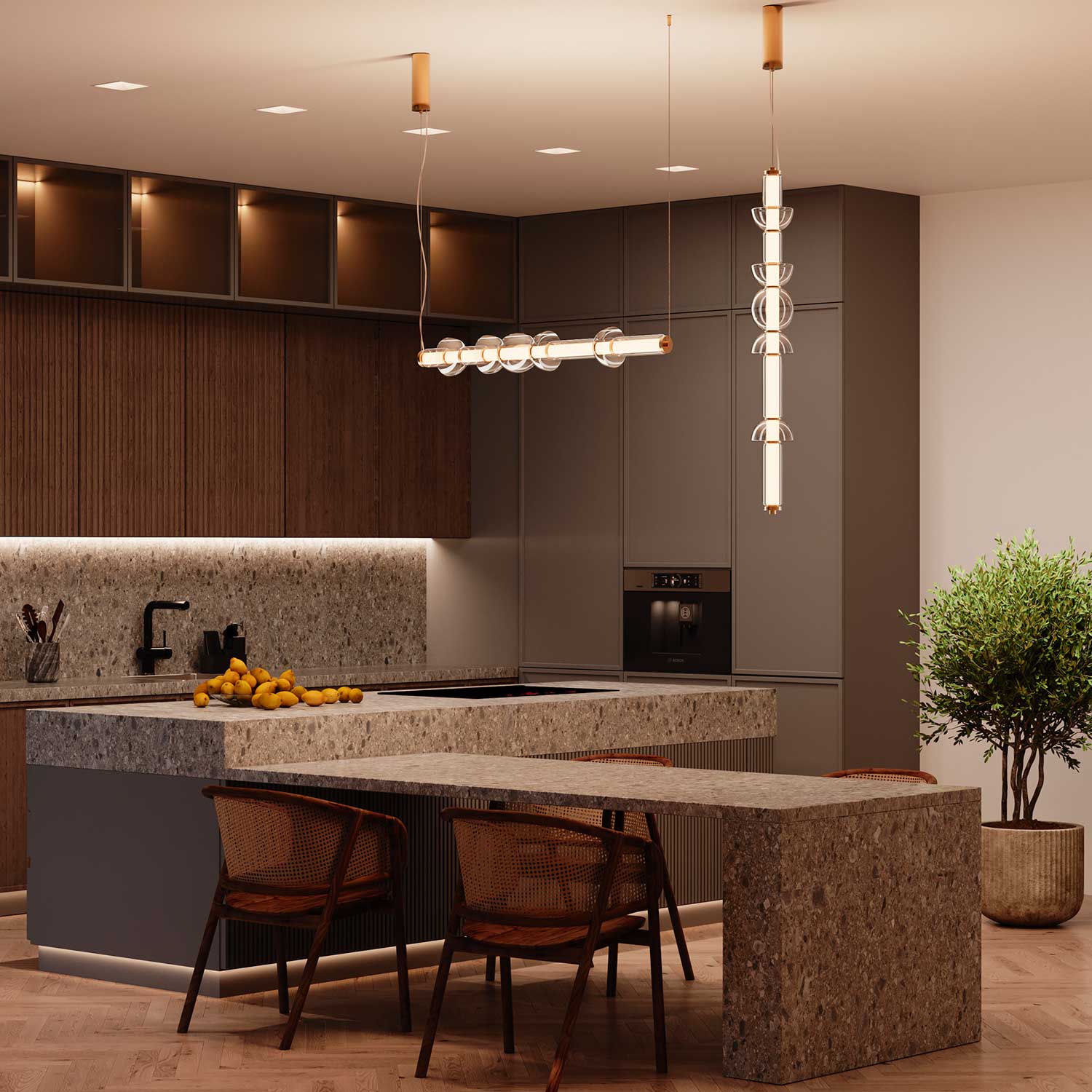
In a kitchen, a light track can be a good alternative to recessed spotlights, especially when you want to illuminate several areas from the same line: countertop, kitchen island, storage, table, or walkway.
A track lighting system allows you to direct the light with greater precision. This can be useful if the kitchen has been modified, if an island has been added, or if the old spotlights no longer match the current layout. Track spotlights can follow the length of a countertop or accompany a dining area.
In a dining room, the rail can replace a series of recessed spotlights by creating light more directed toward the table. It can also be combined with a decorative pendant light when you want to keep a strong centerpiece above the meal while adding more technical complementary lighting.
However, it is important to avoid beams that are too harsh or poorly directed. In a kitchen as in a dining room, the light must be effective without dazzling. The choice of spotlights, their beam angle, and their color temperature therefore remain essential.

Using light rails in a shop, gallery, or showroom
The light rail is a solution particularly suited to shops, galleries, showrooms, and professional spaces. In these places, the layout sometimes changes regularly: new products, new window displays, new collections, new customer routes, or changes in presentation areas.
A commercial light rail allows you to adjust the lighting without redoing the entire installation. The spotlights can be moved or redirected according to the products to be highlighted. This flexibility is very useful for a decor shop, a concept store, a gallery, an exhibition space, or a furniture showroom.
The rail also allows for staging. Rather than lighting the entire sales area uniformly, it becomes possible to create accent zones, guide the eye, and highlight materials. A well-lit product appears clearer, higher quality, and better integrated into the space.
A model like the track lighting for shops can fit into this kind of consideration when the project requires an adjustable, understated solution adapted to precise lighting.
Should you choose a single-phase, three-phase, or magnetic rail?
The choice of rail type depends on the project, the desired level of control, and the use of the space. A single-phase rail is often used for simple installations with a single on/off control. It can be suitable for residential use, a living room, a kitchen, or a small professional space.
A three-phase track offers more flexibility in professional projects. It can manage several lighting circuits on the same track, for example to distinguish general lighting, accent lighting, and specific zones. It is often relevant in stores, galleries, or showrooms.
The magnetic track, for its part, appeals with its more contemporary aesthetic and modularity. The modules can be positioned on the track more flexibly, often with a more architectural look. It can suit high-end residential projects, offices, hotels, or commercial spaces where the design of the system is as important as the light.
The choice should not be based solely on appearance. You must consider the electrical installation, the length of the track, the number of fixtures, the type of control, the available power, and the possible evolution of the project.
How to properly position a ceiling light track?
The positioning of the track is crucial. A poorly placed track can be as disappointing as a bad installation of recessed spotlights. It does not necessarily have to be centered in the room: it must above all be aligned with the areas to be lit.
In a living room, the track can follow a wall to highlight it, accompany a bookshelf, or structure a passage area. In a kitchen, it can be positioned above a worktop or parallel to an island. In a store, it can follow product aisles or circulation paths.
A ceiling track spotlight must also respect the proportions of the room. A track that is too short can seem lost. A track that is too long can weigh down the ceiling. The right length depends on the surface, furniture, areas to be lit, and the number of spotlights needed.
You also need to consider the orientation angles. Spotlights should not be directed straight into the occupants' eyes. They should illuminate surfaces, objects, or useful areas, with an appropriate beam. In a successful project, the light is visible in its effects but rarely bothersome at its source.

Mistakes to avoid in a replacement project
The first mistake is to replace recessed spotlights with a track without overall consideration. The track is not a magic solution. It must meet a specific need: more flexibility, better orientation, a more refined atmosphere, or adaptation to a new layout.
The second mistake is neglecting ceiling repairs. Old holes must be anticipated before the work begins. A beautiful light rail will lose its appeal if the ceiling still shows visible marks, rough patching, or poorly concealed previous installations.
The third mistake is choosing spotlights that are too powerful. A rail allows you to direct light, but this precision can become uncomfortable if the beams are too intense or too narrow. You need to adjust the power, angle, and color temperature to the actual use.
The fourth mistake is to multiply spotlights without hierarchy. A rail does not necessarily need to be filled along its entire length. A few well-placed fixtures can be enough to create elegant, precise, and comfortable lighting.
Finally, aesthetic coherence should not be forgotten. The rail becomes a visible element of the ceiling. Its finish, width, proportions, and the design of the spotlights must harmonize with the interior architecture. A system like the design light rail for interiors can be interesting when looking for a more integrated and contemporary solution.
Choosing your rail lighting with La Lumiere
Replacing recessed spotlights with a light rail can be a great idea during renovation, provided the project is carefully analyzed. This solution is especially suitable when the existing layout is no longer appropriate, when you want to direct light more precisely, or when the space needs to remain adaptable.
In a living room, kitchen, shop, showroom, or office, the rail allows for more flexible lighting than a series of recessed points. It can add more depth, better highlight important areas, and adapt to layout changes.
At La Lumiere, we support individuals and professionals in choosing lighting solutions suited to their project: spotlights on rails, light rails, pendants, wall lights, ceiling lights, or technical lighting. The goal is to select fixtures that match the actual use of the space, ceiling constraints, and the desired atmosphere.
Do you want to replace your recessed spotlights with a light rail? Send us your plans, photos, or ceiling constraints: our team will help you identify the best solution for your project. Contact us!

Leave a comment
This site is protected by hCaptcha and the hCaptcha Privacy Policy and Terms of Service apply.