
How can you modernize a Provençal façade without losing its charm?
Modernizing a Provençal façade does not mean erasing its identity. On the contrary, the most successful renovations preserve the elements that give the house its character: mineral render, canal tiles, shutters, stone, génoise cornice or wrought ironwork, while simplifying certain details that have become too dated. Colors, joinery, exterior lighting, vegetation and the treatment of the surrounding areas can profoundly transform a façade without pushing it into a contemporary style disconnected from its original architecture.
Contents
- Start by identifying what gives the façade its charm
- Modernize the render without losing the Provençal spirit
- Which colors should you choose for a modern Provençal façade?
- Should you keep the traditional shutters?
- Modernize the windows and joinery
- Keep the stone balanced
- Work on the entrance to the house
- Modernize the façade with exterior lighting
- Use vegetation to soften the renovation
- Create continuity with the terrace and surrounding areas
- Mistakes to avoid

Start by identifying what gives the façade its charm
Before any renovation, it is useful to distinguish the elements that are truly characteristic from those that have simply aged. On a Provençal house, the proportions of the openings, the roof pitch, canal tiles, hinged shutters, certain stone surrounds and génoise cornices all contribute directly to the architectural identity. Removing them all at once risks making the house lose what sets it apart.
Conversely, faded render, very dark joinery, overly elaborate railings or outdated light fixtures can be replaced without compromising the Provençal character. The aim is therefore more to streamline than to transform radically.
Modernize the render without losing the Provençal spirit

Render covers the largest surface area of the façade, and changing it is often enough to completely alter how the house is perceived. To preserve a natural Mediterranean style, overly smooth or artificial finishes are rarely the most suitable. Slightly textured render or a mineral finish generally works better with old tiles and stone.
During a renovation, more understated tones can modernize a Provençal house façade without making it feel cold. Stone beige, sand, off-white, certain shades of cream or greige are advantageous alternatives to the highly saturated yellows or oranges sometimes associated with older renovations.
Which colors should you choose for a modern Provençal façade?
A limited palette generally produces a more elegant result. One main color for the render, a second for the joinery and possibly a third for a few details are enough. The tiled roof already naturally provides many warm shades.
Light render can be paired with olive-green, gray-green, beige, warm gray or natural wood shutters. For a more contemporary approach, dark brown or anthracite joinery can work, but it is best used sparingly so as not to create too stark a contrast with the traditional architecture.
It is also important to observe the colors outdoors. Under the Provençal sun, a shade often appears much lighter and brighter than on a small sample viewed indoors.
Should you keep the traditional shutters?
Shutters are often one of the elements that immediately give a Provençal façade its identity. Replacing them with fully visible roller shutters can therefore significantly alter its character.
When their condition allows, modernized Provençal shutters can simply be repainted in a more current shade. Olive green, gray sage green, beige or natural wood preserve the traditional silhouette while refreshing the overall appearance.
If roller shutters are necessary for comfort, they can sometimes be integrated more discreetly while keeping the hinged shutters as an architectural feature. The result then depends on the style of the house and the configuration of the openings.
Modernize the windows and joinery

Replacing the windows improves thermal performance while also updating the façade's appearance. Slimmer profiles, in particular, make the openings look lighter.
On an older house, white is not the only option. Beige, warm gray or brown joinery, or shades close to those of the shutters, can create a more cohesive whole. Large glazed openings can also be used during a renovation or extension, provided that all the proportions of the main façade are not changed without careful consideration.
The contrast between traditional architecture and contemporary openings works particularly well when it remains occasional: a large window overlooking the garden can modernize the house without necessarily transforming its historic façade.
Keep the stone balanced
Stone can add a great deal of character to a Provençal façade renovation, but excessive use can sometimes produce the opposite effect. Artificially covering every wall with stone cladding risks overwhelming the architecture.
When it already exists, old stone can simply be cleaned and highlighted. On a rendered house, a few carefully chosen elements, such as a base, entrance wall, surround or low wall, are generally enough to create a natural link.
Combining stone, light render and understated joinery often creates an appealing balance between a traditional house and more contemporary architecture.
Work on the entrance to the house
The entrance is a relatively small area, but it strongly influences how the façade is perceived. An aging door, an unclear house number or several mismatched accessories can make the whole look less polished.
A wooden door with simple lines, joinery painted in a deep color or a restrained contemporary door can modernize the entrance without clashing with the rest of the house. A stone threshold, a few plants and well-integrated lighting are then enough to create a cohesive composition.
It is preferable to limit the number of visible finishes: the mailbox, handle, number, doorbell and light fixtures can share the same metallic tone to avoid an accumulation of details.
Modernize the façade with exterior lighting
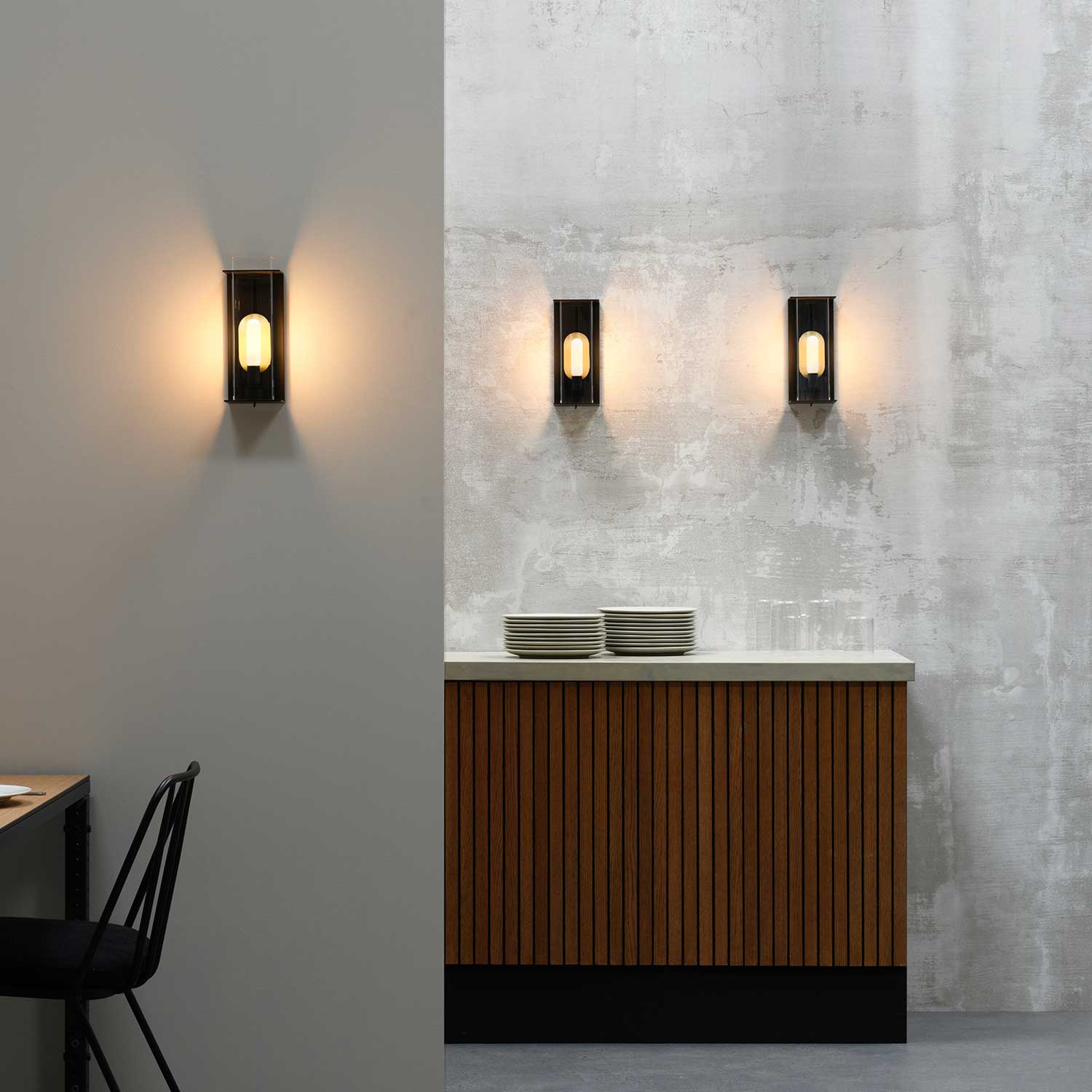
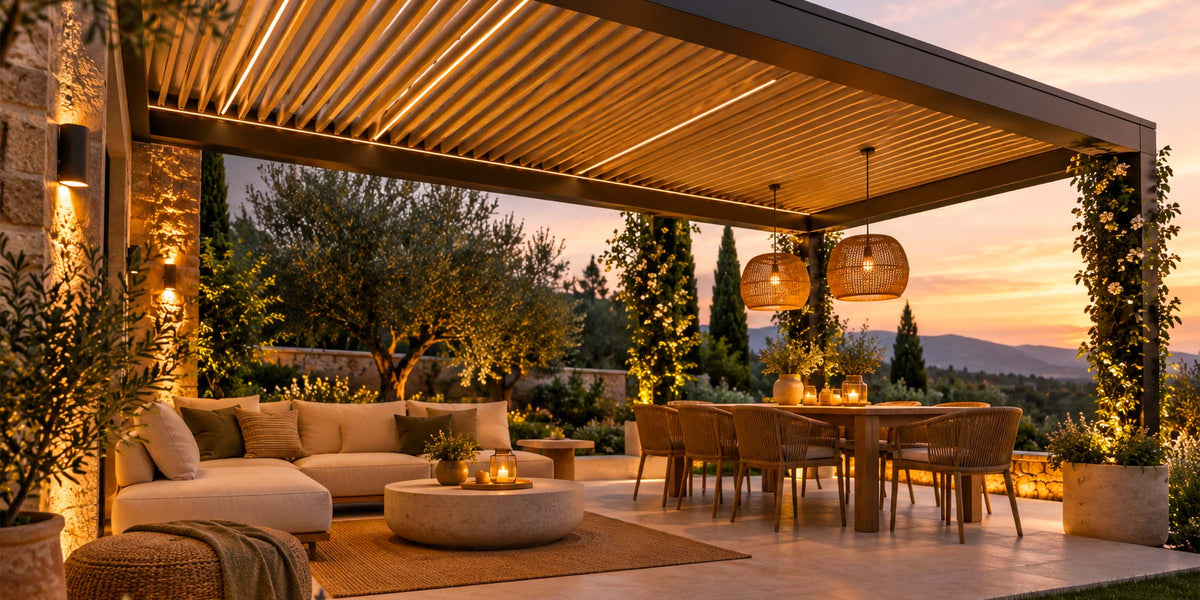
Lighting a Provençal façade can transform its appearance as soon as night falls without altering its architecture. Simple-lined outdoor wall lights can be installed near the entrance door, between certain openings or on the walls bordering a terrace. To preserve a warm atmosphere, light around 2700 K is generally particularly well suited to light render, stone and tiles. It is better to favor a few well-positioned light sources than to illuminate the façade uniformly: light directed upward and downward can highlight the texture of a wall, while more functional lighting should be reserved for entrances and pathways.
Use vegetation to soften the renovation
Vegetation plays an essential role in the image of a Mediterranean house. Olive trees, lavender, rosemary, cypress trees, grasses or climbing plants create a transition between the façade and the garden and prevent a very clean renovation from appearing too rigid.
There is no need to multiply the species. A limited selection repeated in several places generally produces a more contemporary result than an accumulation of different small planting beds.
Plantings can also be used to conceal certain technical elements, accompany a walkway or highlight the entrance without resorting to very imposing landscaping.
Create continuity with the terrace and surrounding areas

The façade should not be considered independently of its surroundings. The terrace flooring, steps, low walls, fences, gate and outdoor furniture all directly contribute to its appearance.
To modernize the whole, it is worth limiting the number of materials. A terrace in light stone or porcelain stoneware with mineral tones, for example, can echo the colors of the render. Low walls rendered in the same color as the house can also create visual continuity.
A very contemporary gate can perfectly complement a Provençal house if its lines remain simple and its color coordinates with the joinery. There is therefore no need to systematically reproduce an old-fashioned style on every exterior element.
Mistakes to avoid when modernizing a Provençal façade
The first mistake is to remove all the traditional markers at the same time. Replacing the shutters, concealing the tiles, removing the stone and using only anthracite gray may certainly create a more contemporary appearance, but the house may also completely lose its identity.
Conversely, insisting on keeping every old element can prevent the façade from evolving. Certain wrought-iron features, colors or decorations added over the decades are not necessarily part of the original architecture and can be simplified.
You should also avoid accumulating materials: stone, wood, black metal, colored render and several types of tile can quickly make a façade look overloaded. Two or three main materials are generally sufficient.
Finally, the façade should be viewed as a whole before choosing each element separately. A beautiful wall light, a beautiful door or a beautiful shutter color may work individually without necessarily forming a coherent composition once combined.
Modernize without erasing the identity of the house
Successfully modernizing a Provençal façade is above all about selecting what deserves to be preserved and what can be simplified. Tiles, proportions, shutters or certain stones can preserve the history of the house, while new render, more understated joinery and better-integrated lighting give it a much more contemporary appearance.
Modernity often comes less from adding new elements than from removing those that have become unnecessary. A more carefully controlled color palette, a few natural materials, structured vegetation and discreet contemporary details can thus update a Provençal house without making it lose precisely what constitutes its charm.


Leave a comment
This site is protected by hCaptcha and the hCaptcha Privacy Policy and Terms of Service apply.