
What power for outdoor lighting?
Choosing the right power for outdoor lighting is essential to achieve a result that is both aesthetic, comfortable, and effective. Too weak, the light does not fulfill its role. Too strong, it becomes dazzling and unpleasant. Contrary to common belief, it is not just about choosing a “powerful” bulb, but finding the right balance according to the use and the area to be lit.
To succeed in outdoor lighting, you need to understand the concept of power, know the needs according to the spaces (terrace, driveway, facade…) and avoid some common mistakes. Here is a simple guide to choose the right light intensity outdoors.

Why power is important
The power of outdoor lighting should not be chosen randomly. It directly influences visual comfort, safety, and atmosphere. Too weak lighting makes movement difficult, while too strong light can create a harsh effect and large shadow areas.
Good outdoor lighting must be powerful enough to illuminate without dazzling. The goal is not to light like daylight, but to create a soft, functional, and pleasant light.
Lumens vs watts: understanding the difference

Today, we no longer talk in watts, but in lumens. Watts measure electrical consumption, while lumens indicate the amount of light produced.
The higher the number of lumens, the more intense the light. For example:
- 200 to 400 lumens: ambient lighting
- 400 to 800 lumens: light functional lighting
- 800 to 1500 lumens: main lighting
Understanding this difference is essential to choose a suitable outdoor LED lighting. For more details, you can check our guide on choosing the bulb for a luminaire.
What power for different outdoor areas
Terrace
For a terrace, favor a soft light, between 300 and 600 lumens per light point. The goal is to create a pleasant atmosphere without dazzling.
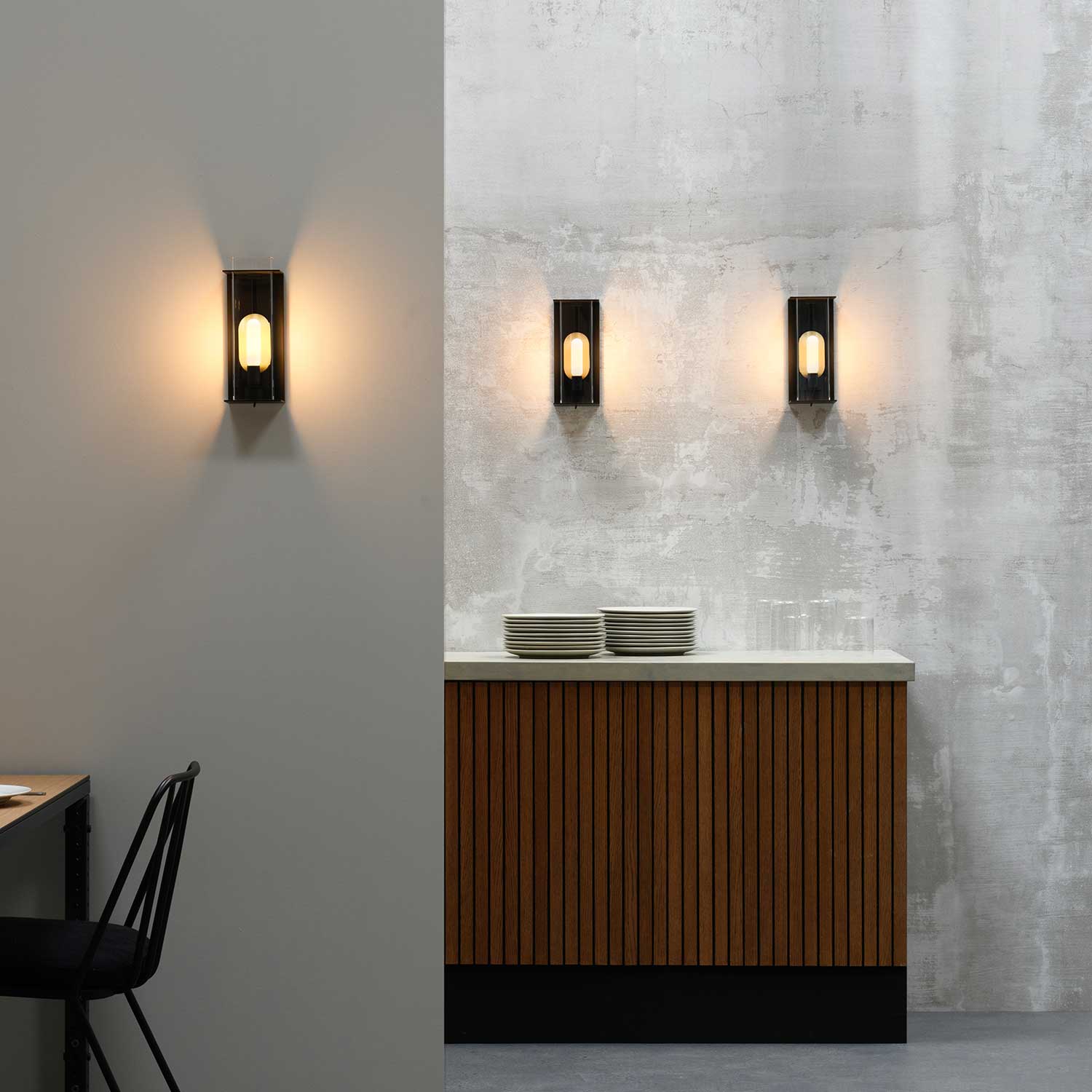
Outdoor wall lights are particularly suitable for this type of space, as they diffuse indirect and warm light.
Driveway or path

A driveway requires functional lighting to secure movement. Power between 200 and 500 lumens is generally sufficient, distributed over several light points.
Outdoor bollards are ideal to mark a path while maintaining soft and non-dazzling light.
House facade
To light a facade, more power is needed to highlight volumes. You can go from 800 to 1500 lumens depending on the size of the wall and the desired effect.
The lighting should be directed to avoid overly contrasted areas and highlight the texture (stone, plaster, wood).
Garden and vegetation
In a garden, lighting should remain subtle. Power of 100 to 300 lumens is often enough to highlight a plant or a flowerbed.
The goal is to create discreet light points rather than uniform lighting.
Entrance and door
The entrance must be well lit for practical and safety reasons. Power of 500 to 800 lumens is generally recommended.
Outdoor spotlights allow precise and effective lighting in this area.
Mistakes to avoid

The first mistake is wanting to light too much. An overly bright exterior loses charm and becomes uncomfortable. It is better to multiply weak light sources than to use a single light that is too strong.
Another common mistake is neglecting the distribution of light. Good outdoor lighting relies on several strategically placed light points.
Finally, avoid lights that are too cold, which give an unwelcoming effect.
Color temperature outdoors
Color temperature plays a key role in the atmosphere. For a warm exterior, favor light between 2700K and 3000K.
Too cold light (4000K and above) gives a white and harsh effect, often unsuitable for residential outdoor spaces.
Good outdoor LED lighting should be both functional and visually pleasant.
Conclusion
Choosing the right power for outdoor lighting is not just about taking a stronger bulb. You need to adapt the light intensity to each area and favor well-distributed light.
By respecting these lumen guidelines and combining several light sources, you can create outdoor lighting that is both aesthetic, comfortable, and perfectly suited to your space.


Leave a comment
This site is protected by hCaptcha and the hCaptcha Privacy Policy and Terms of Service apply.